
DEAR READER, – My parents were both born in Ireland, where they spent the great part of their lives after their marriage. They left Ireland for Scotland, and never returned to the Green Isle. I was born in the year of 1830 in the city of Edinburgh, the garden of bonnie Scotland, which is justly famed by all for its magnificent scenery. My parents were poor, but honest, sober, and God-fearing. My father was a hand-loom weaver, and wrought at cotton fabrics during his stay in Edinburgh, which was for about two years. Owing to the great depression in the cotton trade in Edinburgh, he removed to Paisley with his family, where work was abundant for a period of about three years; but then a crash taking place, he was forced to remove to Glasgow with his family with the hope of securing work there, and enable him to support his young and increasing family, as they were all young at that time, your humble servant included. In Glasgow he was fortunate in getting work as a cotton weaver; and as trade was in a prosperous state for about two years, I was sent to school, where I remained about eighteen months, but at the expiry of which, trade again becoming dull, my poor parents were compelled to take me from school, being unable to pay for schooling through adverse circumstances; so that all the education I received was before I was seven years of age.
My father, being forced to leave Glasgow through want of work, came to Dundee, where plenty of work was to be had at the time — such as sacking, cloth, and other fabrics. It was at this time that your humble servant was sent to work in a mill in the Scouringburn, which was owned by Mr Peter Davie, and there I remained for about four years, after which I was taken from the mill, and put to learn the hand-loom in Ex-Provost Reid’s factory, which was also situated in the Scouringburn. After I had learned to be an expert hand-loom weaver, I began to take a great delight in reading books, as well as to improve my handwriting, in my leisure hours at night, until I made myself what I am.
The books that I liked best to read were Shakespeare’s penny plays, more especially Macbeth, Richard III, Hamlet, and Othello; and I gave myself no rest until I obtained complete mastery over the above four characters. Many a time in my dear father’s absence I enacted entire scenes from Macbeth and Richard III, along with some of my shopmates, until they were quite delighted; and many a time they regaled me and the other actors that had entertained them to strong ale, biscuits, and cheese.
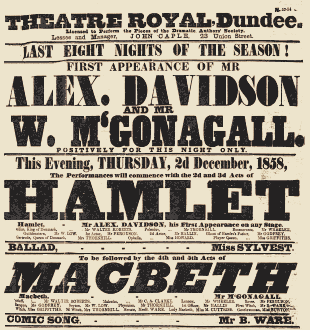 My first appearance on any stage was in Mr Giles’ theatre, which was in Lindsay Street quarry, some years ago: I cannot give the exact date, but it is a very long time ago. The theatre was built of brick, somewhat similar to Mr McGivern’s at the top of Seagate. The character that I appeared in was Macbeth, Mrs Giles sustaining the character of Lady Macbeth on that occasion, which she performed admirably. The way that I was allowed to perform was in terms of the following agreement, which was entered into between Mr Giles and myself — that I had to give Mr Giles one pound in cash before the performance, which I considered rather hard, but as there was no help for it, I made known to Mr Giles’s terms to my shopmates, who were hand-loom weavers in Seafield Works, Taylor’s Lane. No sooner than the terms were made known to them, than they entered heartily into the arrangement, and in a very short time they made up the pound by subscription, and with one accord declared they would go and see me perform the Thane of Fife, alias Macbeth. To see that the arrangement with Mr Giles was carried out to the letter, a deputation of two of my shopmates was appointed to wait upon him with the pound. Mr Giles received the deputation, and on receipt of the money cheerfully gave a written agreement certifying that he would allow me to perform Macbeth on the following night in his theatre. When the deputation came back with the news that Mr Giles had consented to allow me to make my debut on the following night, my shopmates cheered again and again, and the rapping of the lays I will never forget as long as I live. When the great night arrived my shopmates were in high glee with the hope of getting a Shakespearian treat from your humble servant. And I can assure you, without boasting, they were not disappointed in their anticipations, my shopmates having secured seats before the general public were admitted. It would be impossible for me to describe the scene in Lindsay Street, as it was crowded from head to foot, all being eager to witness my first appearance as an exponent of Shakespeare. When I appeared on the stage I was received with a perfect storm of applause, but when I exclaimed “Command, they make a halt upon the heath,” the applause was deafening, and was continued during the entire evening, especially so in the combat scene. The house was crowded during each of the three performances on that ever-memorable night, which can never be forgot by me or my shopmates, and even entire strangers included. At the end of each performance I was called before the curtain, and received plaudit after plaudit of applause in recognition of my able impersonation of Macbeth.
What a sight it was to see such a mass of people struggling to gain admission! hundreds failing to do so, and in the struggle numbers were trampled under foot, one man having lost one of his shoes in the scrimmage; others were carried bodily into the theatre along with the press. So much then for the true account of my first appearance on any stage.
 The most startling incident in my life was the time I discovered myself to be a poet, which was in the year 1877. During the Dundee holiday week, in the bright and balmy month of June, when trees and flowers were in full bloom, while lonely and sad in my room, I sat thinking about the thousands of people who were away by rail and steamboat, perhaps to the land of Burns, or poor ill-treated Tannahill, or to gaze upon the Trossachs in Rob Roy’s country, or elsewhere wherever their minds led them. Well, while pondering so, I seemed to feel as it were a strange kind of feeling stealing over me, and remained so for about five minutes. A flame, as Lord Byron has said, seemed to kindle up my entire frame, along with a strong desire to write poetry; and I felt so happy, so happy, that I was inclined to dance, then I began to pace backwards and forwards in the room, trying to shake off all thought of writing poetry; but the more I tried, the more strong the sensation became. It was so strong, I imagined that a pen was in my right hand, and a voice crying, “Write! Write!” So I said to myself, ruminating, let me see; what shall I write? then all at once a bright idea struck me to write about my best friend, the late Reverend George Gilfillan; in my opinion I could not have chosen a better subject, therefore I immediately found paper, pen, and ink, and set myself down to immortalize the great preacher, poet, and orator. These are the lines I penned, which I dropped into the box of the Weekly News office surreptitiously, which appeared in that paper as follows :–
“W. McG., Dundee, who modestly seeks to hide his light under a bushel, has surreptitiously dropped into our letter-box an address to the Rev. George Gilfillan. Here is a sample of this worthy’s powers of versification :–
Rev. George Gilfillan of Dundee,
There is none can you excel;
You have boldly rejected the Confession of Faith,
And defended your cause right well.The first time I heard him speak,
’Twas in the Kinnaird Hall,
Lecturing on the Garibaldi movement,
As loud as he could bawl.He is a liberal gentleman
To the poor while in distress,
And for his kindness unto them
The Lord will surely bless.My blessing on his noble form,
And on his lofty head,
May all good angels guard him while living,
And hereafter when he’s dead.
P.S.– This is the first poem that I composed while under the divine inspiration, and is true, as I have to give an account to God at the day of judgment for all the sins I have committed.
With regard to my far-famed Balmoral journey, I will relate it truly as it happened. ’Twas on a bright summer morning in the month of July 1878, I left Dundee en route for Balmoral , the Highland home of Her Most Gracious Majesty, Queen of Great Britain and Empress of India. Well, my first stage for the day was the village of Alyth. When I arrived there I felt weary, foot-sore, and longed for rest and lodgings for the night. I made enquiry for a good lodging-house, and found one very easily, and for the lodging I paid fourpence to the landlady before I sat down, and when I had rested my weary limbs for about five minutes I rose and went out to purchase some provisions for my supper and breakfast — some bread, tea, sugar, and butter — and when I had purchased the provisions I returned to my lodgings and prepared for myself a hearty tea, which I relished very much, I can assure you, for I felt very hungry, not having tasted food of any kind by the way during my travel, which caused me to have a ravenous appetite, and to devour it greedily; and after supper I asked the landlady to oblige me with some water to wash my feet, which she immediately and most cheerfully supplied me with; than I washed my sore blistered feet and went to bed, and was soon in the arms of Morpheus, the god of sleep. Soundly I slept all the night, until the landlady awoke me in the morning, telling me it was a fine sunshiny morning. Well, of course I arose, and donned my clothes, and I felt quite refreshed after the refreshing sleep I had got during the night; then I gave myself a good washing, and afterwards prepared my breakfast, which I devoured quickly, and left the lodging-house, bidding the landlady good morning, and thanking her for her kindness; then I wended my way the next day as far as the Spittal o’Glenshee–
Which is the most dismal to see-
With its bleak, rocky mountains,
And clear, crystal fountains,
With their misty foam;
And thousands of sheep there together do roam,
Browsing on the barren pasture, blasted-like to see,
Stunted in heather, and scarcely a tree;
And black-looking cairns of stones, as monuments to show,
Where people have been found that were lost in the snow–
Which is cheerless to behold–
And as the traveller gazes thereon it makes his blood run cold,
And almost makes him weep,
For a human voice is seldom heard there,
Save the shepherd crying to his sheep.The chains of mountains there is most frightful to see,
Along each side of the Spittal o’ Glenshee;
But the Castleton o’ Braemar is moot beautiful to see,
With its handsome whitewashed houses, and romantic scenery,
And bleak-looking mountains, capped with snow,
Where the deer and the roe do ramble to and fro,
Near by the dark river Dee,
Which is most beautiful to see.And Balmoral Castle is magnificent to be seen,
Highland home of the Empress of India, Great Britain’s Queen,
With its beautiful pine forests, near by the river Dee,
Where the rabbits and hares do sport in mirthful glee,
And the deer and the roe together do play
All the live long summer day,
In sweet harmony together,
While munching the blooming heather,
With their hearts full of glee,
In the green woods of Balmoral, near by the river Dee.
And, my dear friends, when I arrived at the Spittal o’ Glenshee, a dreadful thunder-storm came on, and the vivid flashes of the forked lightning were fearful to behold, and the rain poured down in torrents until I was drenched to the skin, and longed to be under cover from the pitiless rain. Still God gave me courage to proceed on my weary journey, until I arrived at a shepherd’s house near by the wayside, and I called at the house, as God had directed me to do, and knocked at the door fearlessly. I was answered by the servant maid, who asked me kindly what I wanted, and I told her I wanted lodgings for the night, and that I was wet to the skin with the rain, and that I felt cold and hungry, and that I would feel thankful for any kind of shelter for the night, as it was still raining and likely to be for the night. Then she told me there was no accommodation; then the shepherd himself came to the door, and he asked me what I wanted, and I told him I wanted a lodging for the night, and at first he seemed unwilling, eyeing me with a suspicious look, perhaps taking me for a burglar, or a sheep-stealer, who had come to steal his sheep — at least that was my impression. But when I showed him Her Most Gracious Majesty’s royal letter, with the royal black seal, that I had received from her for my poetic abilities, he immediately took me by the hand and bade me come in, and told me to “gang in ower to the fire and to warm mysel’,” at the same time bidding the servant maid make some supper ready for the poet and while the servant girl was making some porridge for me, I showed him a copy of my poems, which I gave to him as a present for his kindness towards me, which he read during the time I was taking my supper, and seemed to appreciate very much. Then when I had taken my supper, he asked me if I would be afraid to sleep in the barn, and I told him so long as I put my trust in God I had nought to fear, and that these were the principles my dear parents had taught me. When I told him so he felt quite delighted, and bade me warm my feet before I would “gang oot to my bed i’ the barn,” and when I had warmed my feet, he accompanied me to the barn, where there was a bed that might have pleased Her Most Gracious Majesty, and rolling down the bed-clothes with his own hands, he wished me a sound sleep, and bade me good-night. Then I instantly undressed and tumbled into bed, and was soon sound asleep, dreaming that I saw Her Most Gracious Majesty riding in her carriage-and-pair, which was afterwards truly verified. Well, when I awoke the next morning I felt rather chilled, owing to the wetting I had got, and the fatigue of the distance I had travelled; but, nothing daunted, I still resolved to see Her Majesty. So I dressed myself quickly, and went over to the house to bid the shepherd good-morning and thank him for the kindness I had received at his hands, but I was told by the girl he was away tending the sheep, but that he had told her to give me my breakfast, and she bade me come in and sit down and get it. So of course I went in and got a good breakfast of porridge and good Highland milk, enough to make a hungry soul to sing with joy, especially in a strange country, and far from home. Well, having breakfasted, I arose and bade the servant girl good-bye, at the same time thanking her and the shepherd — her master — for their kindness towards me. Then, taking to the road again, I soon came in sight of the Castleton o’ Braemar, with its beautiful whitewashed houses and romantic scenery, which I have referred to in my poem. When I arrived at the Castleton o’ Braemar it was near twelve o’clock noon, and from the Castleton it is twelve miles to Balmoral ; and I arrived at the lodge gates of the palace of Balmoral just as the tower clock chimed three; and when I crossed the little bridge that spans the river Dee, which has been erected by Her Majesty, I walked boldly forward and knocked loudly at the porter lodge door, and it was immediately answered by the two constables that are there night and day, and one of them asked me in a very authoritative tone what I wanted, and of course I told him I wanted to see Her Majesty, and he repeated, “Who do you want to see?” and I said I was surprised to think that he should ask me again after telling him distinctly that I wanted to see Her Majesty. Then I showed him Her Majesty’s royal letter of patronage for my poetic abilities, and he read it, and said it was not Her Majesty’s letter; and I said, “Who’s Is It then? do you take me for a forger?” Then he said Sir Thomas Biddulph’s signature was not on the letter, but i told him it was on the envelope, and he looked and found it to be so. Then he said, “Why didn’t you tell me that before?” I said I forgot. Then he asked me what I wished him to do with the letter, and I requested him to show it to Her Majesty or Sir Thomas Biddulph. He left me, pretending to go up to the palace with the letter, standing out in the cold in front of the lodge, wondering if he would go up to the palace as he pretended. However, be that as it may, I know not, but he returned with an answer as follows:–“Well, I’ve been up at the Castle with your letter, and the answer I got for you is they cannot be bothered with you,” said with great vehemence. “Well,” I replied, “it cannot be helped”; and he said it could not, and began to question me when I left Dundee, and the way I had come from Dundee, and where I had lodged by the way; and I told him, and he noted it all down in his memorandum book, and when he had done so he told me I would have to go back home again the same way I came; and then he asked me if,I had brought any of my poetry with me, and I said I had, and showed him the second edition, of which I had several copies, and he looked at the front of it, which seemed to arrest his attention, and said, “You are not poet to Her Majesty; Tennyson’s the real poet to Her Majesty.” Then I said, “Granted; but, sir, you cannot deny that I have received Her Majesty’s patronage.” Then he said, “I should like very much to hear you give some specimens of your abilities,” and I said, “Where?” and he said, “Just where you stand”; and I said, “No, sir, nothing so degrading in the open air. When I give specimens of my abilities it is either in a theatre or some hall, and if you want to hear me take me inside of the lodge, and pay me before I begin; then you shall hear me. These are my conditions, sir; do you accept my terms?” Then he said, “Oh, you might to oblige the young lady there.” So I looked around to see the young lady he referred to, and there she was, looking out at the lodge entrance; and when I saw her I said, “No, sir, I will not; if it were Her Majesty’s request I wouldn’t do it in the open air, far less do it to please the young lady.” Then the lady shut the lodge door, and he said, “Well, what do you charge for this book of poems?” and I said ” 2d.,” and he gave it me, telling me to go straight home and not to think of coming back again to Balmoral. So I bade him good-bye and retraced my steps in search of a lodging for the night, which I obtained at the first farmhouse I called at; and when I knocked at the door I was told to come in and warm my feet at the fire, which I accordingly did, and when I told the good wife and man who I was, and about me being at the palace, they felt very much for me, and lodged me for the night, and fed me likewise, telling me to stay with them for a day or two, and go to the roadside and watch Her Majesty, and speak to her, and that I might be sure she would do something for me, but I paid no heed to their advice. And when I had got my supper, I was shown out to the barn by the gudeman, and there was prepared for me a bed which might have done a prince, and the gudeman bade me goodnight. So I closed the barn door and went to bed, resolving to be up very early the next morning and on the road, and with the thought thereof I couldn’t sleep. So as soon as daylight appeared, I got up and donned my clothes, and went to the farmer’s door and knocked, for they had not arisen, it being so early, and I bade them good-bye, thanking them at the same time for their kindness; and in a few minutes I was on the road again for Dundee — it being Thursday morning I refer to — and lodging in the same houses on my homeward journey, which I accomplished in three days, by arriving in Dundee on Saturday early in the day, foot-sore and weary, but not the least discouraged. So ends my ever-memorable journey to Balmoral.
 My next adventure was going to New York, America, in the year 1887, March the 10th. I left Glasgow on board the beautiful steamer “Circassia,” and had a very pleasant voyage for a fortnight at sea; and while at sea I was quite a favourite amongst the passengers, and displayed my histrionic abilities, to the delight of the passengers, but received no remuneration for so doing; but I was well pleased with the diet I received; also with the kind treatment I met with from the captain and chief steward — Mr Hendry. When I arrived at Castle Garden, New York, I wasn’t permitted to pass on to my place of destination until the officials there questioned me regarding the place in New York I was going to, and how old I was, and what trade I was; and, of course, I told them I was a weaver, whereas if I had said I was a poet, they wouldn’t allowed me to pass, but I satisfied them in their interrogations, and was allowed to pass on to my place of destination. During my stay in New York with a Dundee man, I tried occasionally to get an engagement from theatrical proprietors and music-hall proprietors, But alas! ’twas all in vain, for they all told me they didn’t encourage rivalry but if I had the money to secure a hall to display my abilities, or a company of my own, I would make lots of money; but I am sorry to say I had neither, therefore I considered wisely it was time to leave, so I wrote home to a Dundee gentleman requesting him to take me home, and he granted my request cheerfully, and secured for me a passage on board the “Circassia” again, and I had a very pleasant return voyage home again to bonnie Dundee. Since I came home to Dundee I have been very well treated by the more civilised community, and have made several appearances before the public in Baron Zeigler’s circus and Transfield’s circus, to delighted and crowded audiences; and the more that I was treated unkindly by a few ignorant boys and the Magistrates of the city, nevertheless my heart still clings to Dundee; and, while in Glasgow, my thoughts, night and day, were always towards Dundee; yet I must confess, during a month’s stay in Glasgow, I gave three private entertainments to crowded audiences, and was treated like a prince by them, but owing to declining health, I had to leave the city of Glasgow. Since this Book of Poems perhaps will be my last effort,
I earnestly hope the inhabitants of the beautiful city of Dundee
Will appreciate this little volume got up by me,
And when they read its pages, I hope it will fill their hearts with delight,
While seated around the fireside on a cold winter’s night;
And some of them, no doubt, will let a silent tear fall
In dear remembrance of WILLIAM McGONAGALL.

Not a lot one can say…really. A very sad end to his journey to meet the Queen. Was this English prejudice I wonder…against one of the world’s greatest poets? Couldn’t the great Queen and Empress appreciate the subtle forms of his vocabulary, vernacular, grammar and ryme; his catachresic abilities are legendary in my view…and have lasted until this day, where he is more appreciated than ever by us Scots…and even the English, in these days of strong constitutional opposition to referendums on what people think…And to be turned away from America, the land of freedom, of opportunity and democracy, without even the opportunity of giving of his services freely. They didn’t charge Oscar Wilde to play in their theatres and speak easies. and he insulted them terribly, unlike our Willie, who always treated people with kindness and consideration.
he was terrible
In the section where McGonagall talks about his discovery of poetry, “more” is misspelled as “mote”.
Thanks for spotting that, SpaghettiToastBook. I’ve fixed it now.