
My Dear Readers of this autobiography, which I am the author of, I beg leave to inform you that I was born in Edinburgh. My parents were born in Ireland, and my father was a handloom weaver, and he learned me the handloom weaving while in Dundee, and I followed it for many years, until it began to fail owing to machinery doing the weaving instead of the handloom. So much so as I couldn’t make a living from it. But I may say Dame Fortune has been very kind to me by endowing me with the genius of poetry. I remember how I felt when I received the spirit of poetry. It was in the year of 1877, and in the month of June, when trees and flowers were in full bloom. Well, it being the holiday week in Dundee, I was sitting in my back room in Paton’s Lane, Dundee, lamenting to myself because I couldn’t get to the Highlands on holiday to see the beautiful scenery, when all of a sudden my body got inflamed, and instantly I was seized with a strong desire to write poetry, so strong, in fact, that in imagination I thought I heard a voice crying in my ears- “Write! Write” I wondered what could be the matter with me, and I began to walk backwards and forwards in a great fit of excitement, saying to myself– “I know nothing about poetry.” But still the voice kept ringing in my ears – “Write, write,” until at last, being overcome with a desire to write poetry, I found paper, pen, and ink, and in a state of frenzy, sat me down to think what would be my first subject for a, poem. All at once I thought of the late Rev. George Gilfillan, and composed a poem of four stanzas in his praise as a preacher, and orator, and poet. Then I sent it to the “Weekly News” for publication, not sending my name with it, only my initials – W. McG., Dundee. It was published, along with a short comment by the editor in its praise, as follows:– “W. McG., Dundee, has sent us a poem in praise of the Rev. George Gilfillan, and he sung his praises truly and well, but he modestly seeks to hide his light under a bushel” so when I read the poem in the “Weekly News” I was highly pleased no doubt to see such a favourable comment regarding it. Then my next poem, or second, was the “Railway Bridge of the Silvery Tay” , which caused a great sensation in Dundee and far away. In fact, gentle readers, it was the only poem that made me famous universally. The reading of the poem abroad caused the Emperor of Brazil to leave his home far away incognito and view the bridge as he passed along en route to Inverness. But, my dear readers, the Tay Bridge poem is out of print, and I do not intend to publish it again, owing to the fall of the bridge in the year of 1879, which will be remembered for a very long time.
I may also state in this short autobiography of mine that my parents are dead some years ago — I don’t remember how many, but they are buried in the Eastern Necropolis, Dundee, and I may say they were always good to me.
And now concerning something more attractive, my dear readers, I must inform ye that as early as ten years of age I was very fond of reading Shakespeare’s Penny Plays (Vicker’s edition), and from them I received great knowledge regarding the histrionic art. The plays or tragedies I studied most were Macbeth, Hamlet, Richard III, and Othello, the Moor of Venice, and these four characters I have impersonated in my time. During my stay in Dundee my first appearance on the stage was in the character of Macbeth in Mr Giles’ Penny Theatre, Lindsay Street, Dundee, to an overflowing end crowded audience, and I received unbounded applause.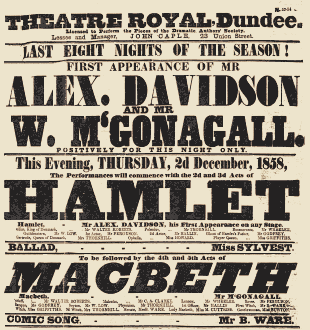 I was called before the curtain several times during the performance, and I remember the actors of the company felt very jealous owing to me getting the general applause, and several were as bold as tell me so; and when it came to the combat scene betwixt me and Macduff the actor who was playing Macduff against my Macbeth tried to spoil me in the combat by telling me to cut it short, so as the audience, in his opinion, would say it was a poor combat, but I was too cute for him, guessing his motive for it. I continued the combat until he were fairly exhausted, and until there was one old gentleman in the audience cried out, “Well done, McGonagall! Walk into him! ” And so I did until he was in a great rage, and stamped his foot, and cried out, “Fool! Why don’t you fall?” And when I did fall the cry was “McGonagall! McGonagall! Bring him out! Bring him out! ” until I had to come before the curtain and receive an ovation from the audience. Such was the case in my second appearance, under the management of Forrest Knowles in the Grocers’ Hall, Castle Street, Dundee. The characters I appeared in under his management were Macbeth, Richard III, and Hamlet. These three characters I performed to crowded and delighted audiences. I remember Mr Knowles told me in the dressing-room that I looked the character so well in the dress that I should wear it, and not throw it off, but I told him it was too great a joke to say so. I also remember on that night there were several gentlemen in the audience who were from Edinburgh, and they came to my dressing-room to congratulate me on my great success, and shook hands with me, telling me that few professionals could do it so well; but perhaps they were only flattering me. If so, I will say with the poet, John Dryden —
Flattery, like ice, our footing does betray,
Who can tread sure on the smooth slippery way ?
Pleased with the fancy, we glide swiftly on,
And see the dangers which we cannot shun.
My dear readers, the next strange adventure in my life was my journey to Balmoral.

I am a fan of William McGonnagall. It was his own account of his life that won me over. OK it is naff and funny because so badly written, but the actual story he tells is touching and tragic, even heroic.
… [Trackback]
[…] Informations on that Topic: mcgonagall-online.org.uk/life/autobiography1 […]
… [Trackback]
[…] Find More on to that Topic: mcgonagall-online.org.uk/life/autobiography1 […]
… [Trackback]
[…] Find More on that Topic: mcgonagall-online.org.uk/life/autobiography1 […]
… [Trackback]
[…] Information on that Topic: mcgonagall-online.org.uk/life/autobiography1 […]
… [Trackback]
[…] Find More on that Topic: mcgonagall-online.org.uk/life/autobiography1 […]
… [Trackback]
[…] Find More Info here on that Topic: mcgonagall-online.org.uk/life/autobiography1 […]
… [Trackback]
[…] There you will find 57238 additional Info on that Topic: mcgonagall-online.org.uk/life/autobiography1 […]
… [Trackback]
[…] Read More on that Topic: mcgonagall-online.org.uk/life/autobiography1 […]
… [Trackback]
[…] Find More Information here on that Topic: mcgonagall-online.org.uk/life/autobiography1 […]
… [Trackback]
[…] Find More Info here to that Topic: mcgonagall-online.org.uk/life/autobiography1 […]
… [Trackback]
[…] Read More on to that Topic: mcgonagall-online.org.uk/life/autobiography1 […]
… [Trackback]
[…] Find More on that Topic: mcgonagall-online.org.uk/life/autobiography1 […]
… [Trackback]
[…] Read More on on that Topic: mcgonagall-online.org.uk/life/autobiography1 […]
… [Trackback]
[…] Find More here to that Topic: mcgonagall-online.org.uk/life/autobiography1 […]
… [Trackback]
[…] There you will find 40142 additional Information to that Topic: mcgonagall-online.org.uk/life/autobiography1 […]
… [Trackback]
[…] Find More on that Topic: mcgonagall-online.org.uk/life/autobiography1 […]
… [Trackback]
[…] Read More on that Topic: mcgonagall-online.org.uk/life/autobiography1 […]
… [Trackback]
[…] Here you can find 29732 more Information to that Topic: mcgonagall-online.org.uk/life/autobiography1 […]
… [Trackback]
[…] Read More to that Topic: mcgonagall-online.org.uk/life/autobiography1 […]
… [Trackback]
[…] Read More on to that Topic: mcgonagall-online.org.uk/life/autobiography1 […]
… [Trackback]
[…] Find More on on that Topic: mcgonagall-online.org.uk/life/autobiography1 […]
… [Trackback]
[…] Read More on that Topic: mcgonagall-online.org.uk/life/autobiography1 […]
… [Trackback]
[…] Here you can find 45910 additional Information on that Topic: mcgonagall-online.org.uk/life/autobiography1 […]
… [Trackback]
[…] Find More on that Topic: mcgonagall-online.org.uk/life/autobiography1 […]